
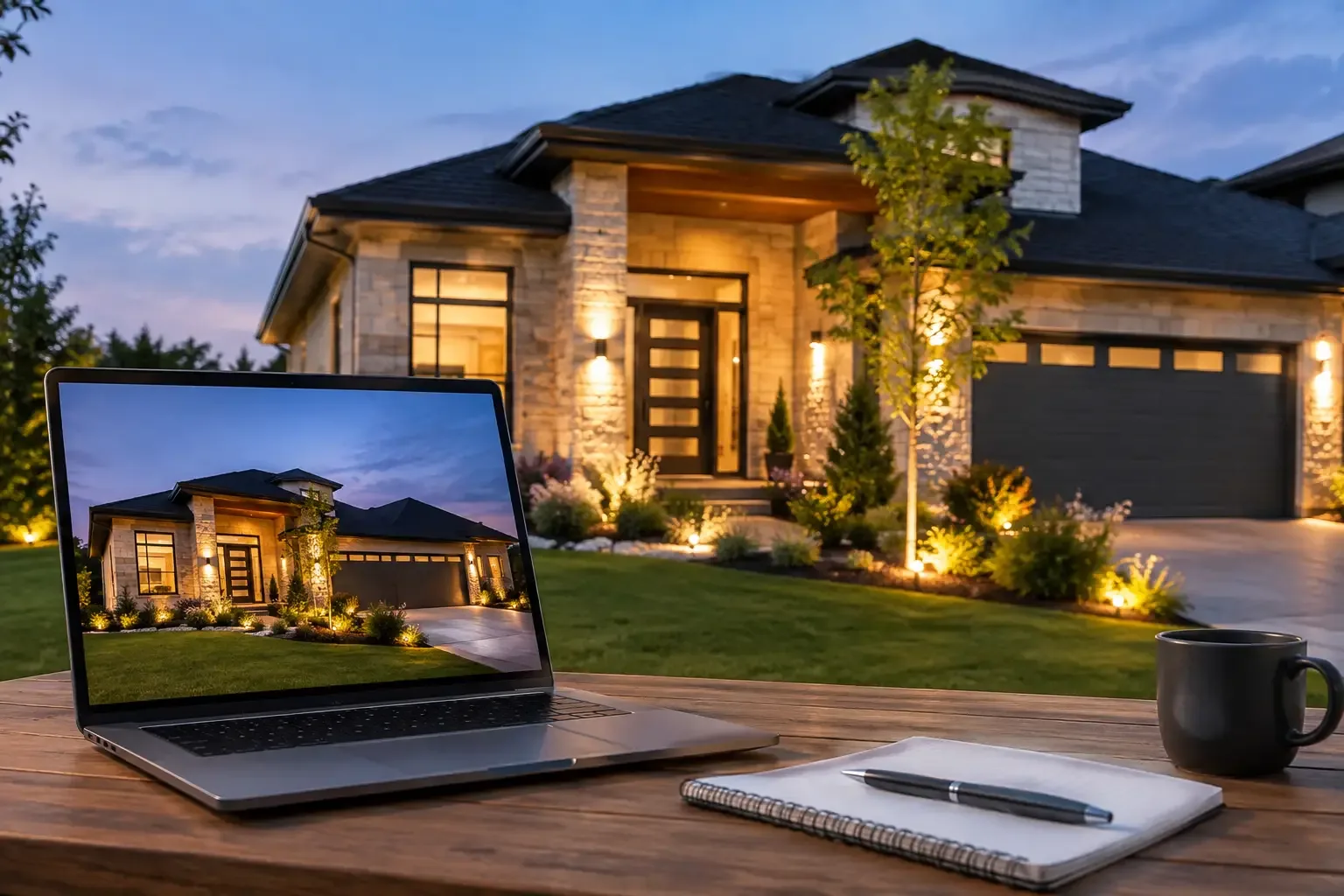
A roofline can look completely different after sunset. The challenge is knowing what will feel refined on your particular home before equipment is installed. An exterior lighting visualizer for home gives you a practical way to see the possibility: a warm-white outline for ordinary evenings, a holiday color scene for December, or a team-color display for game day.
For homeowners across Denver and the Colorado Front Range, that preview can turn a broad idea into a confident design decision. Instead of guessing from a neighbor’s home or a product photo, you can consider lighting in the context that matters: your gables, eaves, peaks, trim colors, and street-facing elevation.
What an Exterior Lighting Visualizer Can Show You
A lighting visualizer begins with a photo of your home, usually one that clearly captures the front roofline. The image becomes a planning surface for mapping where permanent lights may sit and how they could look after dark. It is especially useful when a home has multiple peaks, dormers, garage sections, or a roofline that changes direction.
The best preview is not meant to be a final engineering drawing. It is a design conversation. It helps establish which roofline sections create the greatest visual impact, whether a simple outline feels balanced, and how lighting will relate to the home’s architecture rather than compete with it.
For many homes, the most compelling everyday look is architectural warm white. A clean, measured line along the primary roofline adds definition without making the house feel like it is dressed for a holiday. For celebrations, that same system can shift to full color, using patterns and scenes that fit the occasion.
A visualizer makes that contrast easy to understand. You are not choosing between permanent white lights and seasonal color. You are considering one permanent system with very different settings for different moments.
Start With the View That Matters Most
A good preview depends on a good photo. Take it from the street or driveway at the angle where your home is most often seen. Shoot in daylight with the full front elevation visible, if possible. Avoid photos blocked by vehicles, large trees, seasonal décor, or deep shadows that hide the roofline.
If your home sits on a corner lot, has a prominent side gable, or is often viewed from more than one approach, include those details in the planning conversation. Not every visible edge needs lighting. In fact, selectively lighting the strongest architectural lines often produces the most polished result.
The goal is not to trace every inch of the house. It is to create a composition that looks intentional from the curb. A front-facing gable might deserve attention while a less-visible return does not. A large two-story home may benefit from lighting across several connected roofline sections, while a ranch home may look best with a simpler, continuous outline.
Preview Everyday Warm White Before Holiday Color
Holiday scenes are fun to picture, but everyday warm white deserves equal attention. Permanent exterior lighting becomes a year-round home upgrade when it looks natural on an average Tuesday night, not only during Christmas or Halloween.
In a visualizer preview, look for a warm-white setting that complements the exterior rather than washing it out. Homes with stone, brick, dark siding, or light stucco can all look excellent under roofline lighting, but brightness and coverage should be considered carefully. More intensity is not always better. A measured level often creates a more expensive-looking finish than maximum brightness.
This is where app control adds real value after installation. Homeowners can adjust brightness, set timers, and save a preferred nightly scene without climbing a ladder or changing physical bulbs. You might run a subtle warm-white schedule for evenings, then switch to a brighter display when friends arrive or when you want your home to stand out for a celebration.
Use Color With a Clear Purpose
Full-color roofline lighting creates the most dramatic visualizer images, and it should. A well-planned color scene can make a home feel festive without the tangled wires, uneven strands, and annual setup that come with temporary holiday lights.
Still, color works best when it has a purpose. A red, white, and blue display for Independence Day, orange and purple for Halloween, school colors for graduation, or a favorite team’s colors for a watch party can all feel personal and timely. For Christmas, homeowners can choose classic red and green, a winter white-and-blue palette, or a more playful animated pattern.
The useful question is not, “What can the system do?” It is, “What would we actually use?” If your family enjoys decorating for every holiday, a broad range of scenes may be central to your decision. If you primarily want clean nightly lighting and an easy Christmas setup, your everyday warm-white preview should carry more weight.
What a Visualizer Cannot Decide for You
A preview is valuable, but it does not replace a site-specific installation plan. Photos cannot fully reveal the condition of fascia, access challenges, outlet locations, controller placement, roof pitch, or the best concealed path for wiring. Those details affect the final design and the installation approach.
It also cannot perfectly reproduce how light will read in every real-world condition. Snow, mature landscaping, nearby streetlights, and the color of your siding can change the perceived effect after dark. The preview should be treated as a close visual direction, not a promise that every pixel will appear identical in person.
That is why professional planning matters. An installer can evaluate the home beyond the image, recommend discreet track placement, and identify wiring routes that preserve the clean daytime appearance. The finished system should look integrated with the roofline, not attached as an afterthought.
From Preview to a Clean Installation
Once you have a direction, the next step is turning it into a detailed proposal. The process generally considers the roofline sections to be lit, access needs, equipment placement, and the functions you want from the app. If zones matter to you, such as controlling the garage roofline separately from a front gable, raise that early in the conversation.
At Firefly Exterior Lighting, the design focus is on both sides of the experience: clean by day and unforgettable by night. Low-profile lighting tracks are planned to sit discreetly along appropriate roofline and trim areas, while wiring and controls are placed with care. After installation, homeowners are shown how to use scenes, colors, brightness controls, timers, schedules, and available zones.
That hands-on setup is worth more than a striking mockup alone. The right system should be easy to enjoy on a normal evening and just as easy to transform before a holiday or party.
Questions to Ask While Reviewing Your Preview
Before approving a layout, ask which roofline sections are included and why. Ask how the track will look in daylight, where the controller will be located, and how wiring will be routed. If you want certain areas to operate independently, confirm whether they can be planned as separate zones.
It is also sensible to ask what is included in the proposal, how app training works, and what support or warranty terms apply to your project. Permanent lighting is an investment in convenience and curb appeal, so clarity is part of a good experience.
A visualizer is most useful when it helps you move from “that looks nice” to “that feels right for our home.” Bring a clear photo, picture the home in its everyday warm-white setting, and then have fun imagining the celebrations still to come.