
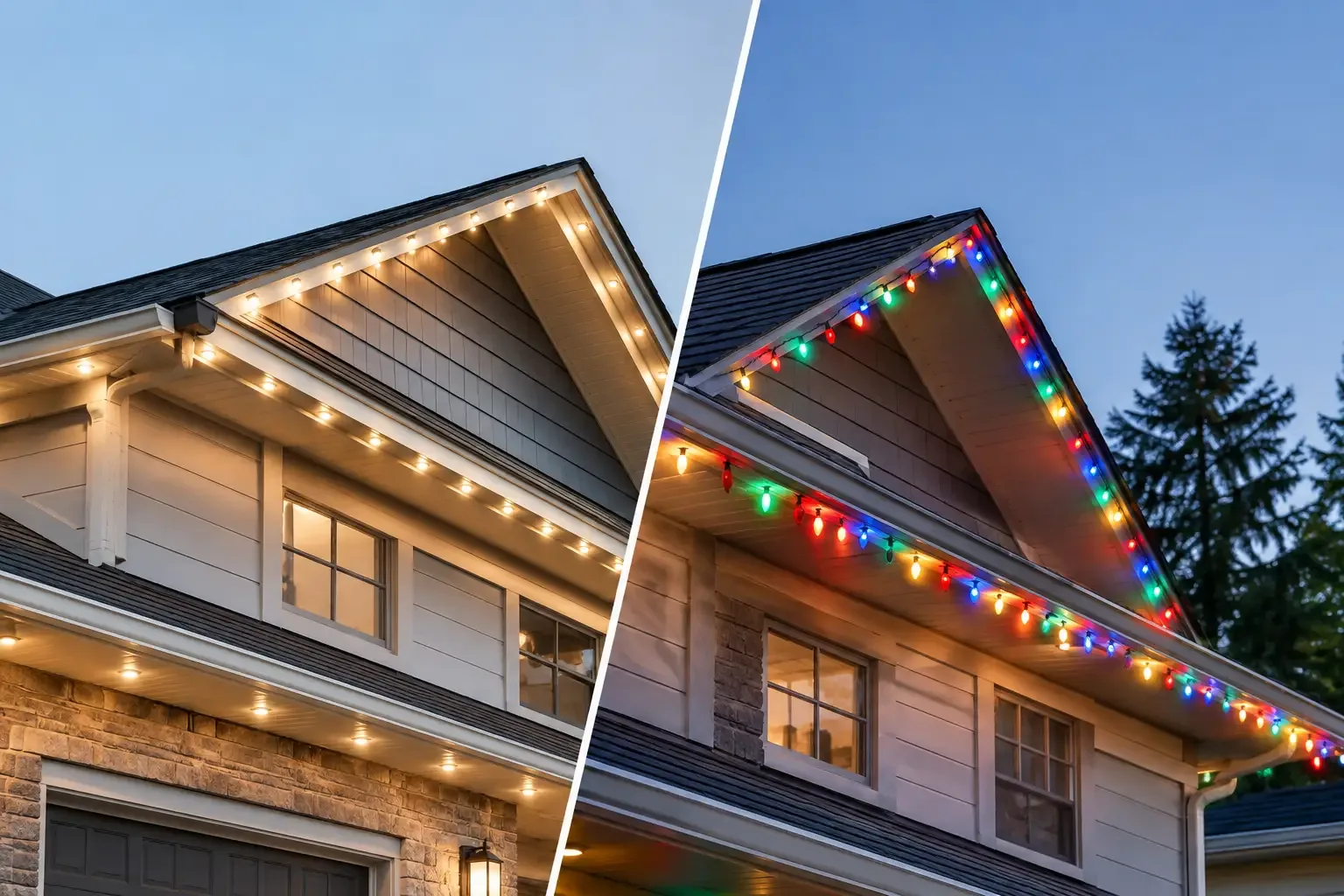
Every November, the same decision returns: climb the ladder, untangle last year's strands, replace a few failed bulbs, and hope the weather cooperates. Comparing permanent lights versus Christmas lights is really a question of whether holiday lighting should remain an annual project or become a polished, year-round part of your home.
For many Colorado homeowners, temporary lights still hold nostalgic appeal. They can be colorful, familiar, and inexpensive to purchase up front. But permanent exterior lighting offers a different experience: clean by day, memorable by night, and ready for much more than December.
Permanent Lights Versus Christmas Lights at a Glance
Traditional Christmas lights are designed for a season. You buy or replace strands, attach clips along the gutters or shingles, run extension cords, set timers, take everything down, and find room to store it all. The result can look wonderful, but it asks for time, ladder work, and a little maintenance every year.
Permanent lights are installed in a low-profile track along selected rooflines and trim. During the day, the system is intended to blend into the architecture rather than read as seasonal décor. At night, homeowners can use warm white lighting for an understated finished look or choose color scenes for holidays, celebrations, and game days.
The biggest difference is not simply the type of bulb. It is the ownership experience. One approach asks you to start over each season. The other is planned around your house once, then controlled from an app whenever the occasion calls for it.
The Case for Traditional Christmas Lights
Temporary Christmas lights remain the right choice for some households. If you enjoy decorating as a family tradition, like changing your display completely every year, or only want lights on the home for a few weeks, standard strands offer flexibility. They also have a lower initial purchase price than a professionally installed permanent system.
There is a creative freedom to seasonal lighting. You can mix oversized bulbs with icicle lights, add wreaths and garlands, or try a new color scheme without being tied to a roofline layout. For homeowners who prefer a bold, temporary display and do not mind the setup, that can be part of the fun.
The trade-off is that the work repeats. Strands can tangle, clips can crack, bulbs can fail, and Colorado wind, snow, and temperature swings can make installation day less predictable. Even a careful setup may involve visible cords, uneven spacing, or lights that shift after a storm.
Temporary lights also ask you to work at height. A one-story ranch may be manageable for many homeowners, while a two-story home with multiple gables, steep pitches, or difficult side-yard access is a different proposition. What starts as a Saturday task can become a job you put off until the weather has already turned.
Why Permanent Lighting Feels Different
Permanent lighting is best viewed as an exterior-home upgrade, not as Christmas lights left up all year. A thoughtfully designed system can support holiday color while adding something useful and refined on ordinary evenings.
A Cleaner Look in Daylight
The daytime appearance is central to a permanent-lighting project. Professional planning considers the roofline, soffit depth, trim color, architectural angles, controller placement, and wiring routes before installation begins. The goal is to position the lighting track discreetly so the house still looks like itself in full sun.
That matters for homeowners who want holiday-ready lighting without a visible string-light look in March, July, or September. Placement is not one-size-fits-all. A home with dark fascia, prominent front gables, stone accents, or a complex roofline needs a layout chosen for its own architecture.
Warm White for Ordinary Nights
Christmas lights tend to stay dark until the holiday season. Permanent systems can earn their place throughout the year with warm white roofline lighting. Set at a comfortable brightness, it can frame the home for evening arrivals, outdoor dinners, or simply a more finished nighttime presence.
This is where restraint makes a difference. Everyday lighting does not need to compete with the neighborhood. A warm white scene can complement exterior finishes and landscaping while giving the home a considered, welcoming look.
Color When the Moment Calls for It
When December arrives, the same system can shift to classic red and green, candy-cane patterns, or a more tailored palette. Halloween, the Fourth of July, birthdays, graduations, team colors, and neighborhood gatherings can all have their own scene without adding a new set of lights to the garage.
App control makes this practical. Instead of manually resetting timers or climbing outside to troubleshoot a connection, you can adjust colors, brightness, zones, schedules, and timers from your phone. The best setup is not the one with the most effects. It is the one your household will actually use because it is easy to manage.
Cost Is More Than the Price of the Lights
The upfront cost is the clearest advantage for traditional Christmas lights. A few boxes of strands and clips cost far less than a permanent installation. But that comparison can be incomplete if you replace lights regularly, pay for seasonal installation, or spend your own weekends putting them up and taking them down.
Permanent lighting is a larger initial investment because it includes design, equipment, professional installation, wiring, controls, and training. Pricing depends on the home itself: roofline length, number of stories, access, complexity, desired coverage, and electrical considerations all affect the proposal.
A useful way to think about the decision is time horizon. If you expect to enjoy a system for years, value year-round warm white lighting, and would rather remove ladder work from your holiday routine, permanent lighting can make sense. If your priority is the least expensive way to decorate only at Christmas, temporary lights may remain the better fit.
Installation Quality Changes the Result
Not all permanent-lighting installations look alike. A polished result depends on more than attaching lights along the eaves. The track needs to follow the home cleanly, corners and transitions need careful handling, and wiring should be routed with the same attention to visibility as the lights themselves.
A consultation-led process helps avoid surprises. At Firefly Exterior Lighting, that typically starts with the home's roofline and your goals: Do you want a subtle warm white look most nights? Is full-color holiday lighting the priority? Which elevations matter most from the street, patio, or backyard? A visual preview and a clear proposal help turn those preferences into a design before installation begins.
After installation, owner training matters too. Homeowners should understand how to select scenes, create schedules, adjust brightness, and use zones without feeling as though they need to become lighting technicians. The technology should make the house easier to enjoy, not add another complicated app to manage.
Which Option Fits Your Home?
Choose traditional Christmas lights if the annual decorating ritual is something you genuinely enjoy, you want a completely different display every season, or you only plan to use roofline lighting for a short holiday window. They are also sensible for a temporary situation, such as a home you expect to sell soon or a budget that does not support a permanent project right now.
Choose permanent lights if you are tired of ladders, storage bins, broken strands, and trying to schedule installation around early winter weather. They are especially compelling on homes with prominent rooflines where a clean architectural outline can add curb appeal well beyond the holidays.
There is also a middle ground. Some homeowners use permanent roofline lighting for the structure and add a few temporary elements, such as lit garlands, yard décor, or a front-door wreath, during Christmas. That approach keeps the difficult, high-up work permanent while preserving room for seasonal personality at ground level.
Plan for How You Actually Live
The right lighting decision is less about chasing the brightest display and more about choosing the routine you want each year. If hauling bins from the garage and climbing a ladder is part of your holiday tradition, temporary lights can still be a great fit. If that routine has become another item on an already full seasonal checklist, a permanent system can give those hours back while keeping your home ready for the next celebration.
Picture the ordinary Tuesday evening, not only Christmas Eve. The most satisfying exterior lighting is the kind that makes you look back at your home after pulling into the driveway, then takes only a few taps to make the next occasion feel special.